
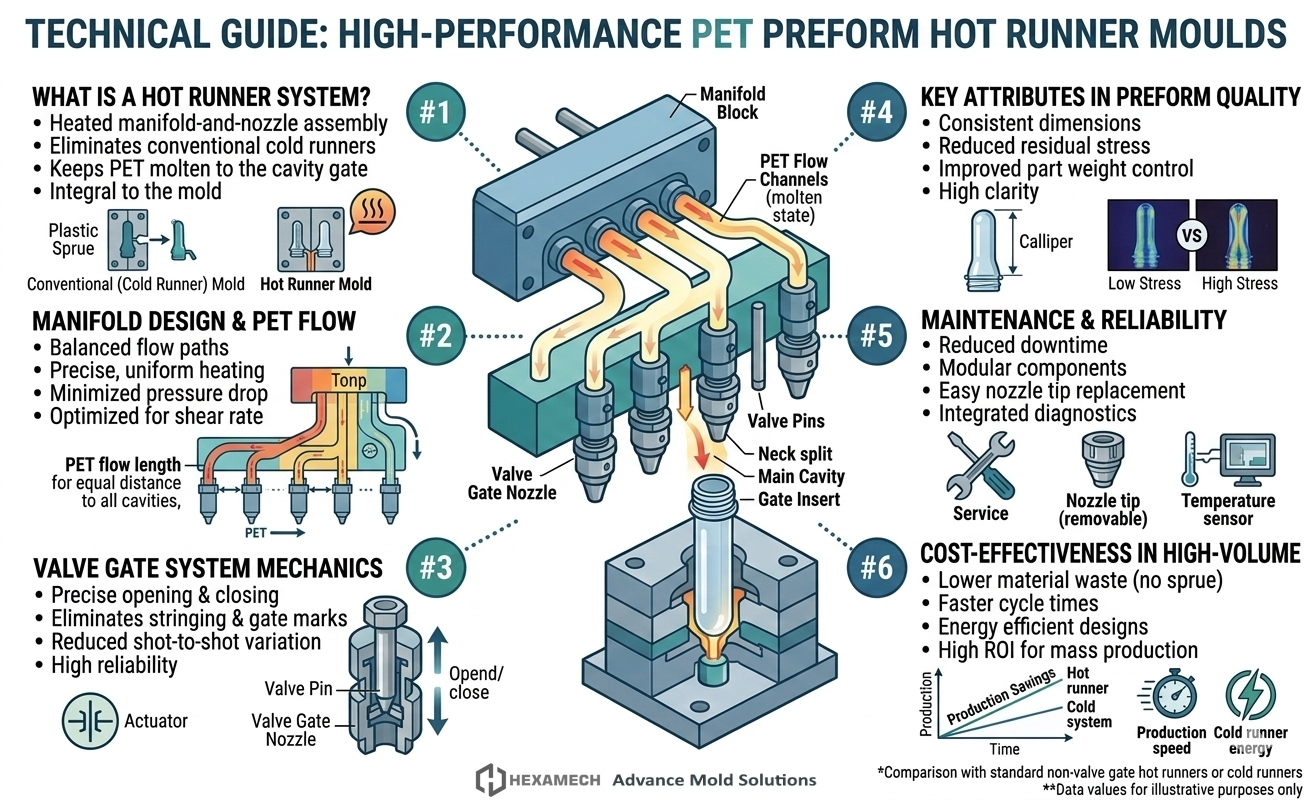
A Complete Technical Guide
Hot runner moulds are the backbone of every high-volume PET preform production line. This guide explains how they work, why they matter, and what separates a well-engineered hot runner system from one that will cost you in quality and downtime.
When a buyer evaluates PET preform moulds, one question comes up more than almost any other: "What type of hot runner system does it use?" And yet, in our experience at Hexamech, many buyers cannot fully explain what a hot runner system is, how it works, or what the technical differences between hot runner configurations actually mean for their production.
This guide exists to close that gap. Whether you are specifying your first preform mould or upgrading an existing line, understanding the hot runner system is not optional — it is central to every important performance decision you will make.
A hot runner system is a heated manifold-and-nozzle assembly built into the mould that keeps PET resin in a molten state from the machine nozzle to the cavity gate — eliminating the cold runner (sprue) that would otherwise form between shots in a conventional mould.
Simplified cross-section of a 4-drop hot runner preform mould system
The manifold is the heated distribution block that receives melt from the machine nozzle and routes it to every nozzle drop. It must maintain a uniform temperature (±2–3°C) across all channels to ensure equal melt viscosity at every gate.
Each nozzle drop delivers melt from the manifold to its individual gate. Nozzles are individually heated and temperature-controlled, allowing fine adjustment of the gate thermal environment per cavity.
The gate is where melt enters the preform cavity. Gate design — tip geometry, orifice diameter, and land length — directly affects gate quality, acetaldehyde generation, and fill balance.
| Feature | Valve Gate | Thermal Gate |
|---|---|---|
| Gate closure mechanism | Mechanical valve pin — positive closure | Freeze-off — tip remains hot, gate cools between shots |
| Gate scar quality | Excellent — flat, clean scar | Good — small vestige may remain |
| Acetaldehyde (AA) generation | Lower — tip cooling reduces heat exposure | Slightly higher — tip must remain molten |
| Cycle time | Faster — positive gate closure | Slightly slower — relies on freeze-off timing |
| Maintenance | Valve pin, actuator, and seal replacement | Simpler — fewer moving parts |
| Recommended cavity count | 32+ (standard for 48, 72, 96, 144) | Up to 32 (low-to-medium production) |
| Best for | Still water, pharma, high-speed production | CSD, household, lower-volume lines |
For still water preforms requiring AA below 1 ppm, valve gate systems are the only reliable choice. The positive closure of the valve pin eliminates the residual heat exposure at the gate tip that drives acetaldehyde generation in thermal gate systems during the dwell between shots.
At Hexamech, hot runner design begins before any mould steel is specified. Our process starts with your resin IV, application (water, CSD, pharma, food), cavity count, target cycle time, and machine platform. From these inputs, our engineering team sizes the manifold bore, specifies the gate geometry, determines zone configuration, and validates the design through Moldflow simulation before manufacturing begins.
Every Hexamech hot runner mould is supplied with individual temperature controllers per nozzle zone, balanced manifold flow paths, and documented commissioning parameters — so your team can hit quality targets from the first production run.
Tell us your cavity count, resin grade, and cycle time target. Hexamech's engineering team will design a hot runner system matched to your production.
Get a Quote → hexamech.com